
The wonders of Barbara Takenaga’s Awestruck
By Bryson Mitchell Burton, TeenTix KC Press Corps Member
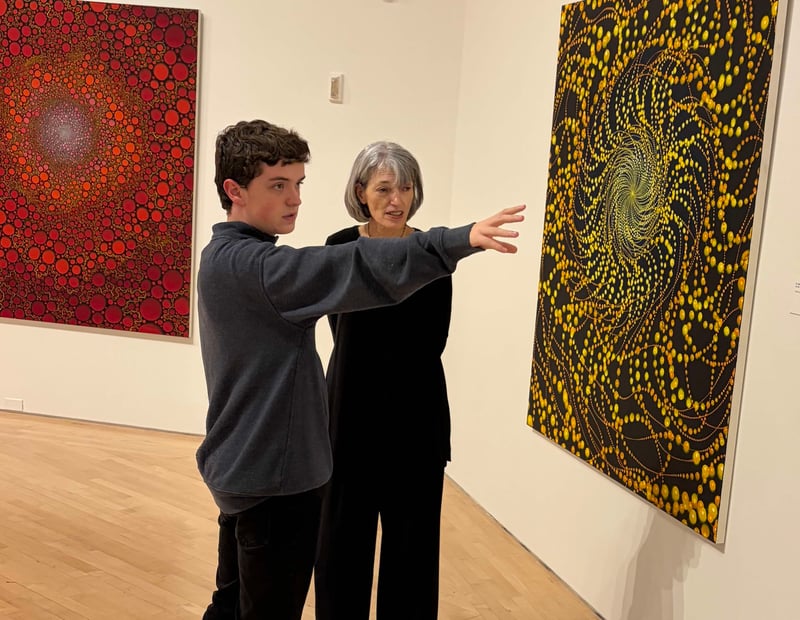
I recently got the opportunity to visit the Kemper Museum and see the stunning Awestruck collection by Barbara Takenaga. The collection was one of the best I’ve seen in a long time. I have a personal soft spot for abstract art, so this one really spoke to me.
Awestruck has a very interesting story, and it starts after 9/11. After the tragic events of 9/11, Takenaga had also lost her mother within a short timespan. Through her grief we get our first bits of art pieces, which I personally find very fascinating. A big difference between her early pieces and the later pieces is that in the first generation, you always get a strong sense of perception. I felt that every time I looked at a piece, I was staring down a wormhole, edge, or crevice. It’s very bizarre in the sense that if you look long enough, you can start to feel dizzy. One of my peers who also toured the exhibit had mentioned a vanishing point, which is another thing that doesn’t reappear until the most recent generation.
Next is the midway generation. I absolutely LOVED this section of art. This section feels more fluid. Some art pieces feel as if they’re literally busting, whereas the earlier pieces would almost always feel like they were falling forward or down in a tunnel. The pieces move like an explosion while some others move like smoke curling upward from a fire. Another difference is the color palette is a little more diverse. The early generation features a noticeable black background in many pieces, and the colors usually stayed to a single color family or darkness. But now there are more expressive colors, white bursting from black with a border of blinding colors. It feels more hopeful than the early generation.
Finally, we have our current generation. This generation has some pieces made during Covid. I find this ironic, because I spotted a few pieces that, while still abstract, showed shapes reminiscent of tiny organisms. This generation has one of my favorite pieces, The Painting for Bontecou. It’s a dazzling spectacle of new and old characteristics of Takenaga’s new and old art styles. It features a more noticeable, deliberate perspective of a tunnel, but combines the same bursting look, with touches of gold. It was, without a doubt, my favorite piece.
Before wrapping up, I would like to share a few opinions from the Kemper Teen Arts Council, who met with the TeenTix KC Press Corps after a tour of the exhibit.
Alex Nowels: “My opinion of the pieces was that it was very, first of all, beautiful, and it was very abstract. It was very different from what Kemper has had before. And I think it really gave a new vision to the museum.”
Cameron Stephenson: “I loved how it really spoke to what's inside, your inner feelings as well as the outward sensations that you can feel [...] like, how your body can guide you emotionally and spiritually and all that.”